Losing a loved one is painful not just because they’re no longer physically there but because there are usually unanswered questions that now can never be asked. That’s exponentially truer when someone takes their own life and those left behind are haunted by the idea that perhaps they could have done something to prevent it. See You When I See You hones in on one family struggling to find their footing following a devastating loss, and one sibling in particular who can’t move forward since he spent so much time with the sister who was also his best friend.
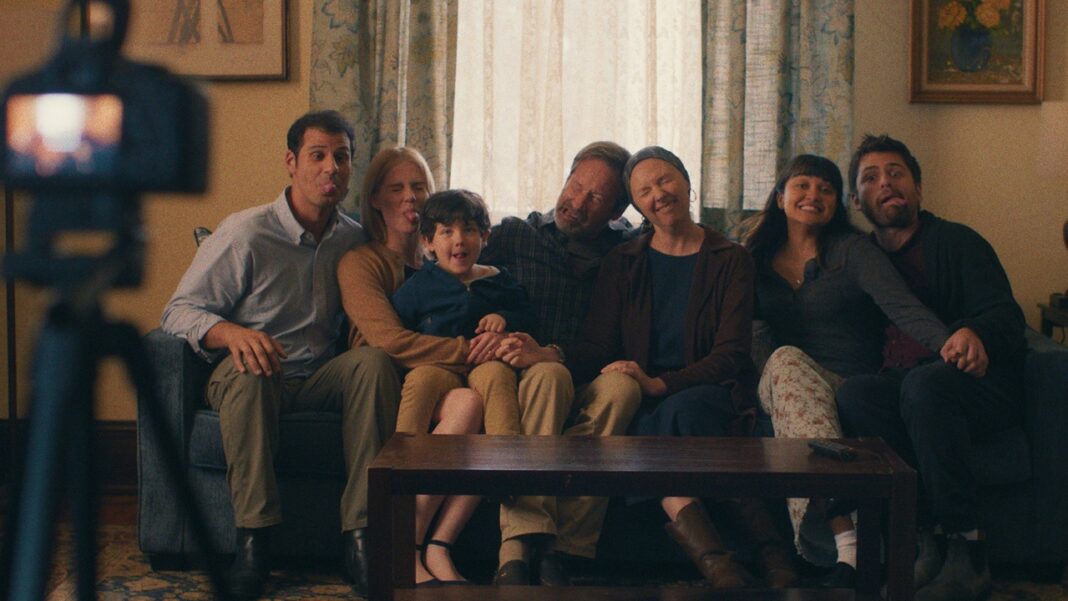
Aaron (Cooper Raiff) and Leah (Kaitlyn Dever) did everything together, and now that she’s gone, he’s in a very bad place. He’s ghosting his girlfriend Camila (Ariela Barer) and tuning out completely at work while making self-destructive decisions that put others in danger. His other sister Emily (Lucy Boynton) is compartmentalizing her grief and throwing herself back into her legal work, where her father Robert (David Duchovny) repeatedly shares about his loss to try to emphasize with clients. Their mother Paige (Hope Davis) is dealing with things her own way, sorting through Leah’s belongings and ignoring the lump she’s found on her breast since that’s just something she doesn’t want to deal with yet. It’s been two months but there still hasn’t been a funeral, mainly because both Aaron and Paige don’t think that’s what they want.
This film comes from director Jay Duplass, who has been at the Sundance Film Festival many times before, and is written by Adam Cayton-Holland, based on his 2019 book Tragedy Plus Time: A Tragi-Comic Memoir. As a comedian, Cayton-Holland worked through his own grief with a humorous slant, which is reflected in Aaron being a comedy writer whose head just isn’t in it anymore and certainly isn’t writing anything funny. While there are plenty of entertaining moments and laughs to be found throughout this film, it’s clear that it’s mainly a mask for what Aaron is going through. Introducing the film’s Sundance premiere, Duplass joked that it was being sponsored by Kleenex. Anyone who has lost someone close to them, which should be most audience members, will find at least one moment or scene to tether to that shows the delicate sensitivity of reengaging with positive memories that have now forever turned sour.
There is a darkness that pervades the otherwise lackadaisical life Aaron leads as he flashes back to some of his best times with Leah only to have those recollections end with her being pulled up to the blackness of space as he yells at her for ruining all their good memories. As Aaron resists different therapies, those moments occur over and over again as he is haunted by them. Coupled with Raiff’s performance, it’s an effective way to showcase the agony Aaron is going through as he lashes out at those who are trying to support him or push him to get the help he needs. Raiff returns to Sundance after a more serious project tinged with humor from last year, the TV series Hal & Harper, and his virtual 2022 film Cha Cha Real Smooth. He’s just endearing enough that it’s possible not to hate him but rather to root for his eventual healing as he tends to make situations worse by refusing to engage with them altogether or confronting them with a less than appropriate attitude.
Though her role is limited, Dever paints a helpful picture of Leah that drives much of the film. Duchovny and Davis are reliable performers who contribute solidly to their characters, even if they’re not as fleshed-out as they could be. Boynton adds considerable depth to Emily, who is also mourning her sister but didn’t have the same closeness that her two siblings did with each other, which further compounds her feeling of disenfranchisement. As someone who genuinely feels for Aaron but isn’t sure she wants to invite him back into her life in this state, Barer delivers the film’s best performance, well-paired with Raiff for scenes that allow them both to show a full range of emotions.
As a look at the way that grief changes people and forces them to confront pieces of themselves that will have to change in their new reality, See You When I See You has moments of poignancy and resonance that feel real and lived-in. As a full film, it doesn’t always go as deep with its supporting players as it does with Aaron, relegating them in the story because they didn’t have the same symbiotic relationship with Leah. This cast is great and it would be wonderful to see more of them, but the focus, understandably, frequently returns to Aaron and how he’s processing all this. Audiences should still find something to connect with even if they identify more with another family member than they do with Aaron in this sensitive and often quite funny depiction of moving slowly and uncomfortably through grief.
Movie Rating: 7/10
See You When I See You premieres in the Premieres section at the 2026 Sundance Film Festival.