A few weeks ago, I had the opportunity to sit down with production designer Jørgen Stangebye Larsen to discuss Sentimental Value as part of our ongoing Oscar coverage for Awards Buzz. As someone who has championed the film since first seeing it at Telluride in September 2025, I was especially eager to dive deeper into the creative process with the artists who helped bring it to life. This marks the first in a series of conversations with the behind-the-scenes team of Sentimental Value.
In our discussion, Larsen broke down the role that a production designer plays in shaping a film’s storytelling. We also explored the remarkable amount of work that went into transforming the house at the center of Sentimental Value into something that feels less like a location and more like a fully realized character. Below is my full interview with Jørgen Stangebye Larsen.
First and foremost, I think this is the best of all of Joachim’s films. To me, it feels like his crowning achievement. Every actor is perfectly cast, the story hits all the right notes, and the filmmaking and visual style are exceptional. I saw it at Telluride, and even after seeing almost a hundred films since then, this one has really stayed with me.
Thank you very much. I appreciate that.
What Does the role of a Production Designer entail?
A production designer joins a project early and works closely with the director—and often the cinematographer—to shape how the film will manifest visually. It’s about building the world of the story.
We ask fundamental questions: What does this world look like? How does it feel? What materials, spaces, and environments support the narrative? A production designer brings ideas that solve practical problems while also adding layers—subtle narratives embedded in architecture, textures, and spatial relationships.
I lead a large department that includes construction crews, scenic painters, prop masters, set decorators, art directors, and graphic designers. It’s a collaborative effort, but I serve as the main creative bridge between my department, the director, costume design, hair and makeup, and the cinematographer. There’s both a practical side—budgeting and logistics—and a deeply creative side.
What is it like to work with Joachim Trier as a creative partner?
He’s very open and personal. This film is deeply personal to him, and the themes—family, siblings, divorce—are relatable to many of us. We connected quickly by discussing our own lives, which helped us understand the emotional core of the script.
He’s ambitious and knows what he wants, but he’s also collaborative. We have in-depth conversations, but at a certain point he gives you the freedom to build the world. That balance makes for a strong creative partnership.
Can you talk about your collaboration with Kasper Tuxen, the film’s Cinematographer?
On this film, Kasper was involved from the very beginning of prep. That made it a particularly rich collaboration. He’s creative, energetic, and loves experimentation.
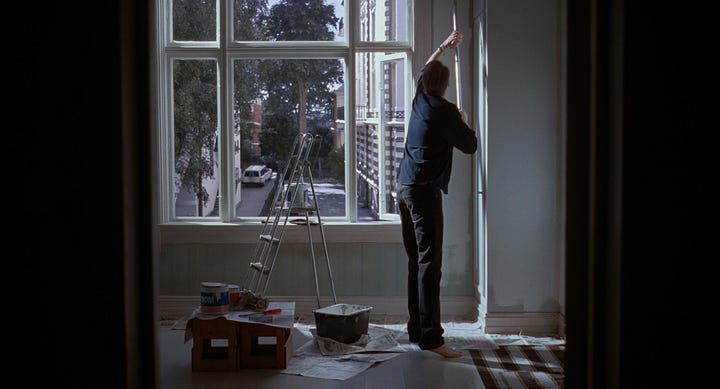
He spoke early on about personal projects involving double exposure and filming interiors while observing life outside through windows. That became a conceptual element in the film—the house observing and absorbing life through its windows.
We also collaborated closely on color palettes and period transitions, working with costume design and the color grading team. Since we built the house in a studio, we worked together extensively, especially using virtual production and LED screens for historical exterior views. The process blended technical problem-solving with creative exploration.
Can you speak a little bit about how you turned the house into a character?
The house had already been selected before I joined the project. Interestingly, it’s the same house we used in Oslo, August 31st, my first film with Joachim after film school.
That felt meaningful because this film is about history—about living with a place over time. The house itself had changed over the past fifteen years, which mirrored the film’s themes.
We also built much of the house in a studio to accommodate multiple time periods. We sometimes had only one to three days to transition between decades—from the 1930s to the 1950s, 1960s, and 1980s. I had to design and construct the second floor entirely, as we didn’t have access to it on location. By the end, I knew that house intimately.
Were there moments where production design shaped the emotional connection to a character?
Yes. For example, Nora’s apartment is intentionally sparse and white. Her life exists outside her home—mainly in the theater. The emptiness of her space reflects her loneliness and her relationship with her father.
There’s also a parallel when the family house becomes increasingly empty after the mother’s death. Both spaces become almost white boxes, reinforcing emotional isolation.
Another important element was the 1980s period depicting Edith and Lilian’s life together. We see only a few interior shots without actors, but I wanted those spaces to suggest a rich life—dusty, colorful, filled with books and art. It was about conveying history and emotional depth visually, even in brief moments.
What are you most proud of in the final film?
I’m most proud of the time-period transitions. We recreated multiple decades—1918, the 1920s, 1950s, 1980s, 2000—and each had to feel authentic but not romanticized.
We used real references, including historical photographs of the house from the 1940s. I worked closely with Joachim to feel comfortable with the earliest periods, which are furthest from our own experience. The visual journey moves from a cluttered, detailed past to a stripped-down present. I’m proud that nothing disrupts that progression.
What was the production timeline on this?
I began around March. We shot in August and wrapped in November. We had 65 shooting days, which is long for a feature, especially compared to most independent films.
Having that time was invaluable. A larger budget allowed us to work properly and thoughtfully. Time is often the most valuable resource money can buy.
How did weather play a role in the production?
The story spans multiple seasons—summer, fall, and winter—so we had to manage seasonal continuity carefully. Sometimes we created weather ourselves, such as dressing snow for the funeral scenes. It’s common in film to simulate seasons—shooting Christmas scenes in summer or summer scenes in winter.
What film do you think deserves to have Awards Buzz?
I haven’t seen as many films as usual because I’m currently pursuing a PhD in production design and working on multiple projects. But I recently saw Begonia. I found it very interesting, particularly the ending from a production design perspective. It surprised me and made me want to revisit it.