Knowing that death is happening soon has the ability to serious alter a person’s perspective and outlook on the time they have left. The chance to preserve some form of life after death can be extremely alluring, even if it’s not for the person who dies but rather as a way to remain behind for those who are still living. Anima tells a story set in a world where digital consciousness uploads are becoming more readily available but uses that merely as the backdrop for a very human, breathing story of one person about to leave this world and the other person sent to bring him to the physical place where he’ll end his life.
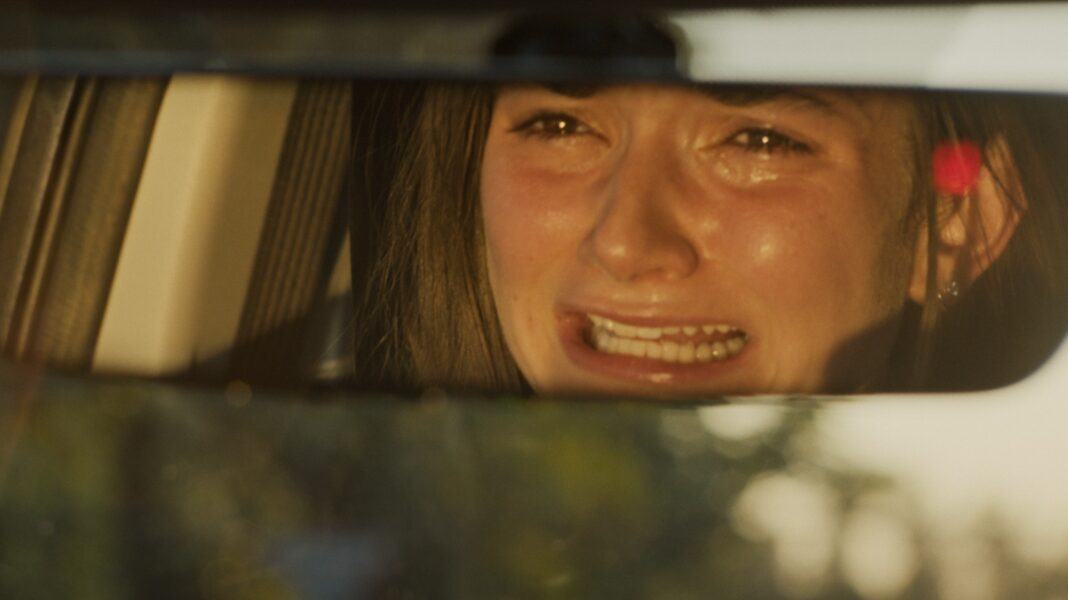
Beck (Sydney Chandler) isn’t having an easy time holding down a job, constantly tossed out of new opportunities because she lacks a skill set in these future-facing industries. Working with a company that produces synthetic pets leads to an introductory assignment at Anima Technologies, where people are digitally copied for their loved ones to visit after their deaths. They’ve had a recent problem with clients changing their minds at the last minute, so Beck has been tasked with driving Paul (Takehiro Hira) from his home to his in-office appointment. What she thinks is going to be an easy job bringing a dying man to his final (immortal) resting place ends up being a longer and more challenging journey when Paul includes a few stops along the route to say what he needs to say to a few important people in his life.
Brian Tetsuro Ivie, who has experience as a documentary filmmaker and producer, makes his narrative feature directorial debut with a relatively simple and straightforward story which takes some loose inspiration from his own life. The sci-fi setup serves only as a guiding force for the main plot, but there’s little about this world that feels any different from how our world looks today. His commitment to celluloid-only projects adds a nostalgic filter to this film, which enhances the quieter moments along the road trip that these two strangers take to unexpectedly learn a great deal about each other and forge a bond even though they couldn’t lead more different lives.
Chandler, who broke out recently with a starring role as a synthetic hybrid on Alien: Earth, plays a character who doesn’t necessarily let people in all that much more. When she tells her mother (Maria Dizzia) that she’s not supposed to emote in this job, she sarcastically replies that it shouldn’t be too hard for her. Chandler does manage to convey a subtle and gradual shift in empathy and care for this man she’s never met, and watching her trajectory from impatient irritation to deep connection is affecting. Hira, who had indicated to his director that his English-language roles to date had been playing either samurai or villains, follows up a film with similar themes, Rental Family, with a touching and reserved portrayal of a man who has spent his life telling other people what to do as the head of a button company as he comes to terms with the fact that he’s no longer in control.
Chandler and Hira share most of the film’s scenes, and their duet is a beautiful one, which adds considerably to a purposefully sparing script. Audiences might be intrigued to see more of the featured technology in place or to spend a great deal of time with the copy Paul is set to make for himself, but Tetsuro Ivie makes the smart choice to remain grounded in the land of the living instead, revealing who Paul is by the way that the people he needs to resolve things with respond to him and in turn how Beck reacts to those exchanges, offering more judgment than she should in her role as a company employee. That’s precisely what this film’s message seems to be, that technology can only take us so far, and it’s up to us to make sure we don’t lose what makes us human.
Movie Rating: 8/10