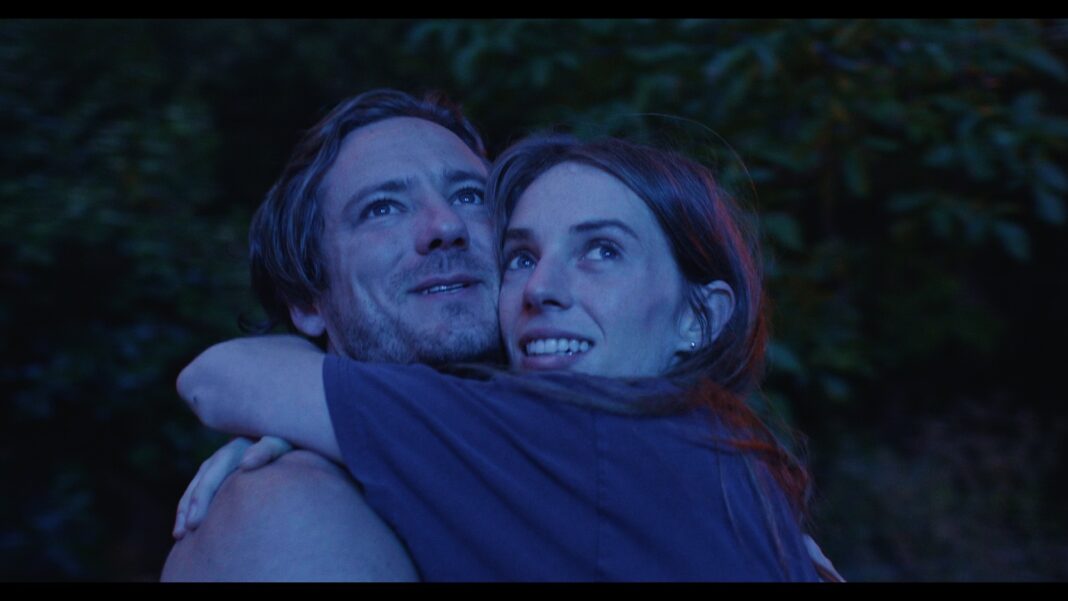
Words and actions in a relationship have consequences, but rarely does every exchange and mood affect the rest of the world in a significant way. Graham Parkes makes a wondrous feature directorial debut with a film that gives its central couple a tremendous power they don’t even understand, tapping into the way they feel about each other and applying that mood to developments in their lives and international markets and events. It’s a remarkably creative and free approach to a relationship movie, finding humor in how its characters come to comprehend this power they have and sincere drama in the pain they’re able to cause each other.
Julia (Maya Hawke) and Charlie (Lewis Pullman) are theoretically happy, but they fight all the time. A casual suggestion by Charlie that they just take a spontaneous trip to Italy is met too quickly with a blunt reply from Julia that she has to consider her busy work schedule, and after they go through a series of arguments and end on a good note, they return to the same place they started. After Julia’s best friend Ella (Amita Rao) signs them up for a relationship seminar hosted by twin gurus the Tillies (Kate Berlant) and they undergo an unconventional therapy session onstage, they soon find the world around them is beating to the same drum as their ability to connect, with their happiness afforded the literal power to change fortunes.
This film inhabits a very interesting space since it is guided by its sci-fi setup but never rests all that heavily on it, allowing things to happen in the background and be noticed by its protagonists but never to dominate what is very much a human-centered romance that happens to have this magical twist. From its first moments, these people feel real and the way in which they just can’t quite get along is communicated along with the history of how they’ve been together. There’s clearly a spark but also a sense that they’ve grown apart as their lives have taken different paths and the dream jobs they hoped to have ended up morphing into something much less ideal.
Hawke and Pullman are both talented performers who have made names for themselves that separate them from their actor parents, and it’s a delight to see them acting opposite each other here. This role finds Hawke playing what may be her most normal character yet, still full of spunk and attitude but generally acclimated with the world and how to function within it. Pullman is typically reserved to a degree but shows considerably more enthusiasm when his perspective is challenged and he jumps in to defend himself (or his mother, with whom he has a very close relationship). Together, it does feel like they’re capable of making the earth move, tapping into each other’s insecurities and showing the complexities of a relationship where they don’t necessarily want the same things.
This film’s premise is applied in very clever ways, especially when Julia wants to demonstrate her hypothesis about what’s happening to Charlie and suggests that they insult each other as much as possible to see the effects. Both actors are bringing their all and these characters are so richly-written that it’s impossible not to be captivated by their back-and-forth. It really does feel as if these people represent their own universe, stepping out of it to interact with colleagues and friends but sufficiently obsessed with each other to allow any disagreement to alter their stability and hinder their productivity. In her small dual role, Berlant is absolutely hilarious, and the lighter, funnier moments help balance out the film’s more serious underbelly. Parkes’ feature debut is a marvelous exploration of how people fuel and tax each other, adding just enough spin to a standard romance to make it distinct, funny, and moving.
Movie Rating: 8/10