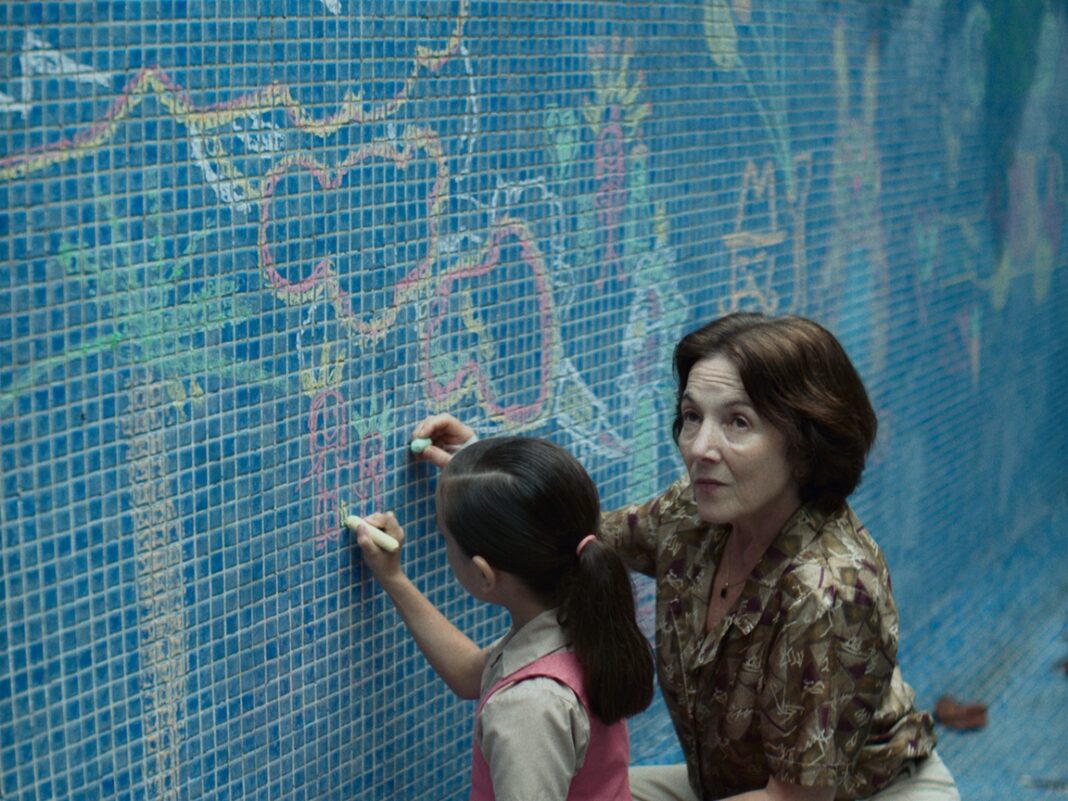
Being separated from family is an unimaginable thing, especially when it’s not by choice. People grow up and necessarily grow apart as a result of work and life decisions and moves, but larger world events can have a significant impact on the ease and possibility of travel. In Neto Villalobos Brenes’ Love is the monster, public health concerns mean that one grandmother can’t be with her granddaughter as often as she’d like, but when it becomes clear that she might no longer have any access to her, she goes to desperate measures to express the love she feels for this young child.
In order to see her granddaughter (Gloriana Vargas), Abuela (Paulina García) must drive to a security gate and make sure she’s on the list. If her granddaughter comes with her in the car, she has to wear a protective face mask to help her breathe. There are no men around, and Abuela enjoys a frosty relationship with her daughter (Natalia Regidor), who is among the high-powered mothers that live in a sprawling property and employ help around the house. Circumstances worsen as the workers express rightful anger at not being paid and the connection Abuela has with her granddaughter is threatened by opportunities for access and her own zealous efforts to maintain a relationship that cuts much deeper than the one she has with her own daughter.
In his third film to screen at the festival, Brenes crafts a brooding, atmospheric thriller that couldn’t be more of a departure from his previous comedies. It’s also one that builds tension organically, following Abuela as she drives down a dark road lined with trees with a moody, ominous score to indicate that even a simple journey shouldn’t be regarded as such. There are many questions that go unanswered, leaving audiences to come up with their own theories of the catalytic events for the world as it functions within this film. But it ultimately doesn’t matter since this is evidently how the world works now, and everyone must adjust to this new existence, harsh as it may be.
García is a tour de force performer who previously commanded the screen in a Toronto International Film Festival selection, Gloria. Here, she makes the movie, bringing a lifetime of experience and pent-up frustration to the way in which this character, who feels like she was born to be a doting grandmother, has so little control of the way things are around her. She knows when to offer what little money she has for safe passage and not to anger the wrong people, but she’s also not able to prepare for every situation, including the coldness which her own daughter directs at her when she pushes to spend a little more time with the object of her affection.
This is most definitely not a fun film, especially since it puts young children in the crosshairs of very adult battles which in no way prioritize their wellbeing. But it’s also a film that builds upon itself in a very simple and unsuspecting away, allowing standard conversations and bingo games to be opportunities for suspense and dread. Just as García is tremendously talented, so too is Vargas in her first screen credit. The scenes the two of them share, which account for a majority of the film, feel real and lived-in, particularly when the granddaughter shows a visible discomfort, not at the presence of her grandmother but at her legitimate concern that she’s doing something unexpected and unpredictable. Love is the monster is a compelling exploration of what people do for the ones they love, and what it means to truly be selfless when there’s no good option to pursue.
Movie Rating: 7/10
Love is the monster makes its world premiere in the Centrepiece section at the 2026 Toronto International Film Festival.