It’s not often that an Oscar-winning film from an auteur ends up with a sequel starring the cast member who took home an Oscar returning for the role. The mere existence of The Further Mis-Adventures of Cliff Booth is even more intriguing given that Quentin Tarantino is back only as screenwriter, while David Fincher, who opted not to direct another such follow-up out this year, The Social Reckoning, takes the reins behind the camera. Tarantino’s previous multi-volume saga, Kill Bill, was filmed all at once and always planned as two parts, whereas this film wasn’t in the cards back in 2019. While the origin story of this film may be unusual and full of red flags, the product speaks for itself, offering two hours and twenty minutes of distinct and irreverent entertainment that, at least for this reviewer who wasn’t enthralled by the first film, might actually be better.
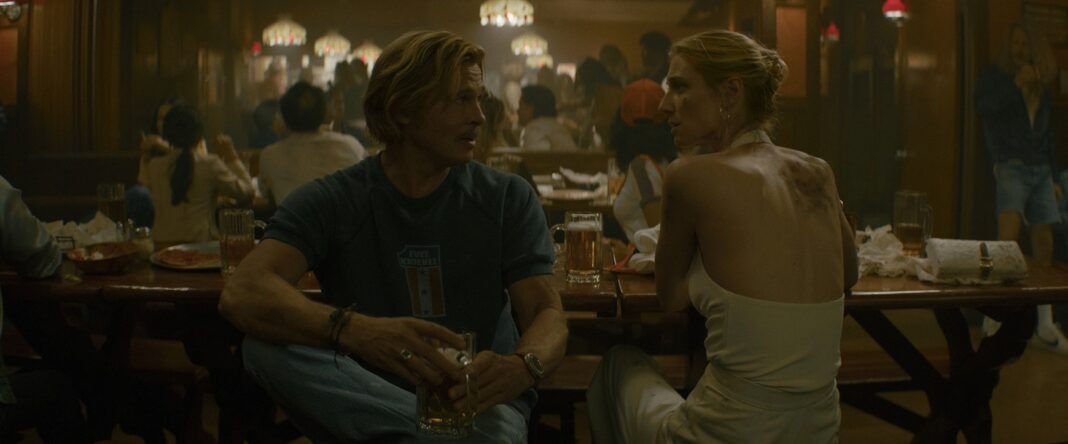
Eight years after the events of Once Upon a Time in… Hollywood, Cliff Booth (Brad Pitt) isn’t living large as a stuntman, working instead in a movie theater while moonlighting as a fixer. After dealing with two men who have stolen from a famous Hollywood director, Booth is contacted by Karen Crosby (Elizabeth Debicki), who works as an agent for the self-aggrandizing TV star Charlie Peters (Scott Caan). Booth is more than happy to spend time with Crosby even if he’s not sure exactly what Peters, who famously does his own stunts, wants with him, though he may just be the man for the job when Peters reveals his unfortunate entanglement with two Filipino mobsters (Matt Groove and JB Tadena) with a penchant for cruel bloodbaths when they dispatch of their targets.
It’s very possible that someone who hasn’t seen this film’s predecessor might not actually be missing much. Booth’s reputation precedes him, and his infamous fight with Bruce Lee is referenced and retold multiple times throughout the film. Rick Dalton (Leonardo DiCaprio), for whom Booth doubled, is also mentioned repeatedly – not so favorably by Booth’s father Gus (Peter Weller) – but he’s like a specter who exists only in the past, a remnant of Booth’s old life who might have done plenty for him but who simply doesn’t factor into the equation now. Things seemed to be going better then, but there’s a case to be made that Booth is exactly where he should be in the job he now finds himself in, even if it’s far from glamorous.
Tarantino’s imprint is visible all over this film even without him directing, and the script features some killer dialogue that fits its characters perfectly. Peters in particular is quite a memorable personality, and Caan delivers Tarantino’s words in a way that makes him even more unbearable in the best way, so into himself that it’s hard to imagine he hasn’t been taken down a peg, especially considering he’s famously short and doesn’t want anyone to know it. Carla Gugino is a great on-screen partner for him as Peters’ wife who has a history with Booth. This is also a superb vehicle for the film’s standout, Debicki, who at first seems straight-laced and easily irritated by the antics of both Booth and Peters, but soon reveals a less serious side that’s a wonder to watch. This proves that this Emmy- and Golden Globe-winning actress should be working more since she excels in any project lucky enough to find her.
Pitt, who took home his first – and only to date – acting Oscar for the role of Booth, returns to a part that finds him seeming very natural and at home. A running joke involves the fact that he’s clearly much older than everyone thinks since he served in World War II (at a very young age, but still) and that many strangers says that they feel like they’ve seen him before. Pitt has been working steadily since his first outing as Booth but this is easily his strongest turn since then, exempting another and much wilder classic Hollywood figure in Babylon. Having someone else play the part would have been a non-starter, but in large part due to his movie star status, he’s more than able to carry the film all by himself without DiCaprio returning even just for a short scene.
Audiences even mildly familiar with Tarantino will prepare themselves for graphic violence, and like Once Upon a Time in… Hollywood, it’s more spaced out than a majority of his films. Its R rating still includes strong/disturbing violence and bloody images, and for the most part, it’s of the typically showy and stylized kind. One unnecessarily upsetting inclusion involves the stark execution of two children, meant to indicate the unchecked ruthlessness of their killers but out of place in a film that ultimately lands on entertainment as its primary service. Apart from that, Fincher and Tarantino make great collaborators, delivering a strong visual style and pacing that doesn’t make this 140-minute film feel short but instead like a series of vignettes that string together nicely. Its extended opening is among its best moments, and its finale feels like classic Tarantino fare. Its IMAX-to-Netflix release strategy may be a head-scratcher since those two formats couldn’t be any different, but watching this at home should be just as immersive and fun, provided audiences opt to enjoy the whole thing in one sitting. It’s a frenetic period fever dream that resurrects a character many might have been happy to leave where he ended and won Pitt his Oscar, but this second outing is surprisingly well-rounded and might even be superior to the first.
Movie Rating: 7/10