For decades, Hollywood chased bigger: bigger budgets, bigger stars, bigger screens.
Now, one of the fastest-growing sectors of the entertainment business is proving that the future may actually be much smaller.
Specifically, it may fit right inside the palm of your hand.
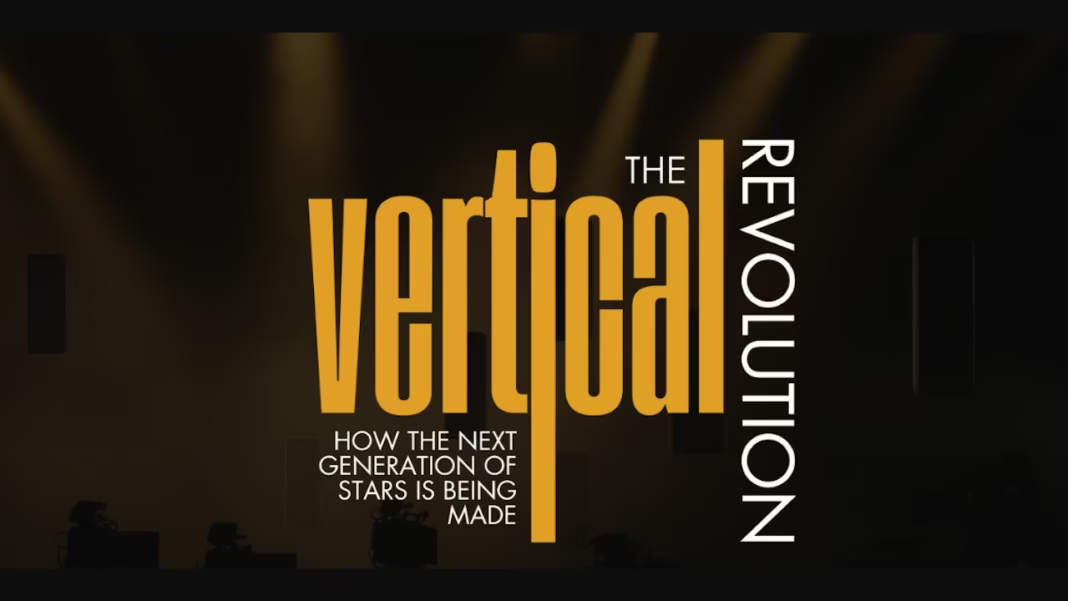
At the recent Vertical Revolution Summit in Los Angeles, filmmakers, producers, actors, and tech executives gathered to discuss what many now believe is one of the industry’s most disruptive emerging formats: vertical microdramas, scripted episodic series designed specifically for the 9:16 smartphone frame.
And if there was one clear takeaway from the two-day event, it is this: vertical storytelling is no longer a novelty. It is quickly becoming a legitimate business model, a creative pipeline, and for many artists, a new entry point into an increasingly difficult Hollywood landscape.
This is not simply traditional television turned sideways.
It is an entirely new language of storytelling.
“Verticals meet the audience where they are at,” filmmaker Jason Thomas Mayfield, producer and head of casting at Snow Story Productions, explained during one of the summit’s panels. “It’s an inherent relationship with the medium, building a direct one-on-one relationship with the audience and asking what they are excited about.”
That direct audience relationship is precisely what makes the vertical format so different — and why so many in the entertainment space are now paying close attention.
Zak Barnett Studios, Paul Ruddy Casting, and Eris Entertainment joined forces to create what felt less like a niche conference and more like a summit for an industry currently writing its own rulebook. The event featured educational panels, workshops, an open casting call, and a VIP networking party, all centered around a format that is evolving at a startling pace.
Hollywood at Hyper Speed
Traditional television productions may shoot only a few pages of script per day.
Vertical productions are often shooting 10 to 20.
Budgets are tighter. Schedules are shorter. Seasons are massive. Most productions wrap in just 10 to 15 days, with episodes typically running one to three minutes and full story arcs often spanning 60 to 100 installments.
There is little room for hesitation.
As several panelists emphasized throughout the summit, confidence and efficiency are non-negotiable. Decisions must be made quickly, resources must be stretched intelligently, and everyone from the actors to the crew must arrive ready to move at a relentless pace.
Actor and producer Cayman Cardiff, who has built a sizable following in the vertical space, addressed one of the biggest misconceptions surrounding microdramas — that they are somehow less legitimate than film or television, or merely disposable content.
“That is not true,” Cardiff said. “It’s a film-TV hybrid that is mobile device driven. They are fun, exciting, and fresh. It’s a new way to consume media and a great opportunity for actors to gain experience and reach new audiences.”
And unlike many traditional productions where rehearsal and refinement can happen over time, vertical sets demand immediate adaptability. Actors are expected to know their lines, understand the tone, and shift gears on command. Writers are often adjusting scripts in real time, sometimes receiving notes based on viewer retention data and platform analytics.
Imagine network notes — but sped up to match the rhythm of social media.
As the format expands, conversations around professionalism are also evolving. Multiple speakers emphasized the growing necessity of intimacy coordinators, intimacy riders, and stronger on-set protections to ensure that the race for speed does not come at the expense of performer safety.
Because at the center of every production is one singular mission: keep the audience watching.
The Billion-Dollar Scroll
The vertical microdrama model first gained serious traction in China in 2018 through short-form video platforms. By 2024, the market had reportedly grown into a business worth more than $7 billion, and Hollywood has taken notice.
Apps such as ReelShort and DramaShorts have already built substantial user bases, while several additional U.S.-based competitors are expected to launch in the coming months.
The formula is deceptively simple: fast episodes, addictive cliffhangers, emotionally heightened storytelling, and an app ecosystem built to encourage one more click, one more chapter, one more unlock.
But beneath that simplicity is a deeply data-driven machine.
Platforms track retention, completion rates, and viewer behavior with extraordinary precision. Storylines can be adjusted based on what audiences are responding to in real time. Genres can pivot. Character arcs can stretch. Hook moments can intensify.
The audience is not just watching the content.
In many ways, they are shaping it.
Financially, however, the model is still finding its footing in the American market. Some projects are ad-supported, others operate behind paywalls or episode unlock systems, and budgets vary significantly depending on the platform’s investment level.
Romance remains the dominant genre, but creators are now pushing aggressively into horror, sports, thriller, and comedy in an effort to broaden both demographics and advertiser appeal.
Reinventing the Casting Pipeline
One of the more fascinating conversations at the summit centered around how vertical content may fundamentally reshape the casting process.
Darren Darnborough, actor and creator of the popular performer platform We Audition, unveiled his new venture VertiCast, a matchmaking tool built specifically for the vertical boom.
“VertiCast is basically the Tinder for vertical casting,” Darnborough explained. “It aims to get producers and casting directors connected with the right cast for their project within three clicks.”
The larger significance is obvious: vertical content is creating so much demand, and at such speed, that traditional audition funnels are often too slow to keep up.
VertiCast and similar technologies are attempting to reverse the usual burden of submission by making it easier for producers to discover talent directly.
“This way it puts the onus on the producer to find their talent, and we’ve made it easier for them to do that,” Darnborough added.
For working actors shut out of an increasingly contracted television landscape, that could prove to be a major shift.
The New Independent Frontier
Perhaps the most empowering takeaway from the summit was this: no one is waiting for the studios.
Panelists repeatedly urged filmmakers to stop viewing vertical as a format that requires permission.
Shoot 10 episodes. Build an audience. Prove the concept. Then sell it.
The mentality feels reminiscent of the early YouTube and digital creator boom, when artists who could not get in through Hollywood’s front gate simply built their own entrance.
Buzz Leer, host of The Vertical Buzz, perhaps summarized the moment best.
“It’s clear that vertical entertainment isn’t emerging anymore. It has crossed the line from curiosity to category,” Leer said. “What we’re witnessing is not a trend, but the rapid evolution of a fully formed ecosystem of creators, platforms, and audiences redefining how stories are made, discovered, and consumed in real time.”
That sentiment was echoed by Zak Barnett, who sees vertical as one of the few areas in Hollywood right now where the gatekeeping still feels unfinished.
“It’s an accessible group of people,” Barnett shared. “For artists, Hollywood has been such a grind before you get to that moment where your voice can be heard. This is a much more level playing field and feels like we are all on the playground creating it together.”
Not a Trend — A Warning Shot
Hollywood has spent the last several years trying to figure out where the next sustainable wave of audience engagement will come from.
Streaming is overcrowded. Network television is shrinking. Mid-budget film continues to fight for oxygen.
Meanwhile, millions of viewers are already consuming serialized stories on the device they never put down.
That is why vertical storytelling matters.
Not because it is quirky.
Not because it is cheap.
And not because it is social media friendly.
It matters because it is meeting modern viewing habits in real time while much of the traditional industry is still trying to catch up.
For creators willing to move fast, think lean, and adapt to a data-obsessed audience, vertical may not simply be another format entering the marketplace.
It may be Hollywood’s clearest warning shot that the rules of serialized storytelling are changing.