

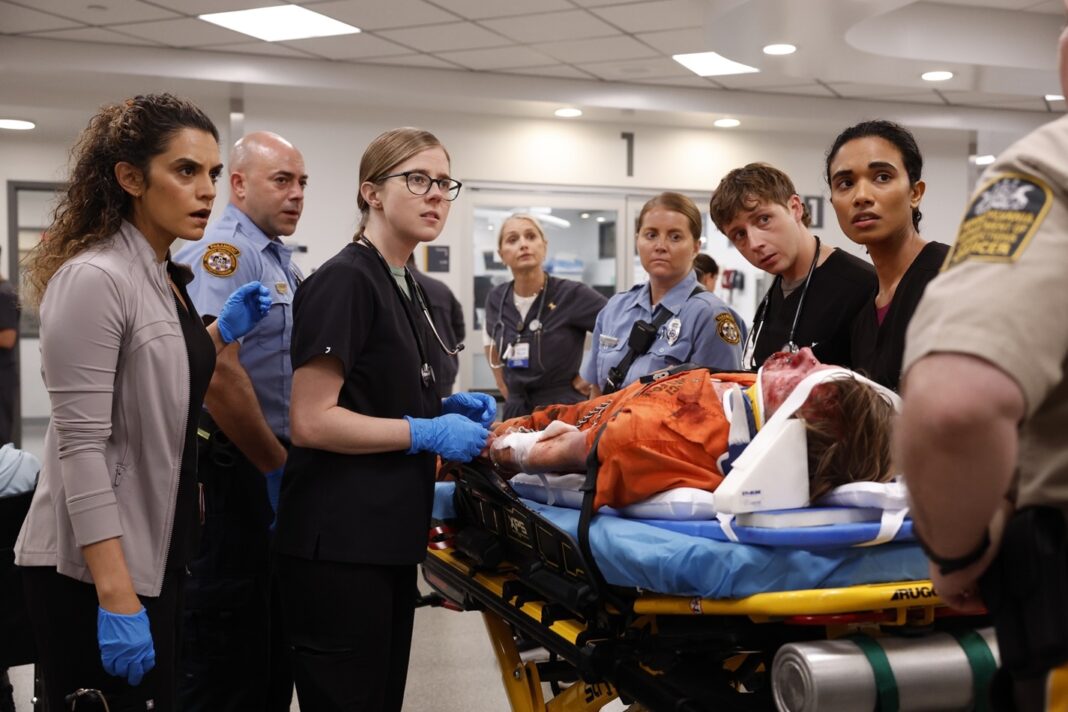
Few shows in recent memory have achieved the level of mass popularity that The Pitt has, appealing to a range of audiences and accessible both as a procedural-style medical drama and a more rewarding regular watch for those willing to get to know the characters. Almost exactly a year to the date that the series first premiered, season two keeps everything that worked about season one in place, with even higher stakes and intensity mixed with more than a little bit of levity that comes from the quick exchanges among the many emergency room workers running around nonstop for fifteen hours straight.
While this series is often praised for its realism, perhaps the least believable thing would have been that the same exact staff would be working on another day. It’s worth putting that aside, however, to welcome back the entire ensemble aside from Tracy Ifeachor, the one departing cast member from season one. Joining the cast is Sepideh Moafi, whose past TV credits into The L Word: Generation Q and Black Bird, as Dr. Baran Al-Hashimi, an attending physician with a completely different outlook from that of Dr. Robby (Noah Wyle). Their scenes together are fantastic, with both arguing conflicting approaches and trying not to step on each other’s toes while also insisting that their way is worth at least considering. Their banter is fun but also indicative of more serious friction in the evolving practice of medicine, from patient-centered care to the use of AI technology to streamline paperwork and efficiency.
That’s where this show is truly and uniquely successful, in incorporating the way the world works into drama that’s legitimately compelling. There are numerous – seemingly uncountable – moments of humor thrown in as these overworked medical professionals face life-and-death moments yet still find time to bet on intake numbers and give each other a hard time for small mistakes and far graver missteps. The writing is excellent and speaks to the way that each of these doctors and nurses handles every situation in a manner that reflects their worldview or, at the very least, the mood they find themselves in at a particular moment of interaction.
Far removed enough from the devastating trauma of peak COVID, Robby is now about to head out on sabbatical right after his final shift, which happens to fall on the Fourth of July. It’s his first time meeting Dr. Al-Hashimi, and also marks the return of Dr. Langdon (Patrick Ball), who has been through rehabilitation programs and is fully penitent, an attitude warmly received by all save for Robby. There’s a humble sorrow to how Langdon faces up to what he did and realizes how much it’s set him back, and it’s an informative and potent spin on the character which showcases Ball’s range, especially in comparison to the steely and sometimes condescending confidence he exuded in the first season.
While Emmy winners Wyle and Katherine LaNasa, as charge nurse Dana Evans, are still terrific, this show smartly gives almost equal screentime to its younger supporting cast members. As Mel (Taylor Dearden) worries about her first deposition, Santos (Isa Briones) grumbles about being chastised for being behind on her charting and then having no time to catch up, Javadi (Shabana Azeez) struggles to keep her ambition under wraps, and Whitaker (Gerran Howell) frets about doing the wrong thing, it’s clear that each of these characters are rich, layered, and interesting, and still being developed, allowing the actors to get to know them with each new episode. Supriya Ganesh and Fiona Dourif are also dependably excellent as Dr. Mohan and Dr. McKay, respectively, who are certainly cooler under pressure but still not immune to the demands of their work.
It’s rare to find a show that remains gripping for the entirety of fifteen episodes, barely offering a respite from the onslaught of new cases and returning complications, yet still opts to drop just one installment at a time. It’s a sign that every episode stands well enough on its own, and it’s better to give each the time it needs to make an impact. There’s no ticking clock like on 24, but that’s actually a benefit here, since audiences will likely forget that time is passing as swiftly as it is since it’s near impossible to find a moment to take a breath. Season two is easily as good as season one, and once the credits roll on episode fifteen, those watching will finally be able to breathe but also surely find the wait for season three agonizing in the best way.
Season grade: 9/10


[…] Season 2 keeps everything that worked in place, with even higher stakes and intensity mixed with more than a little bit of levity that comes from the quick exchanges among the many emergency room workers running around nonstop for 15 hours straight.— Abe Friedtanzer, Awards Buzz […]
[…] Season 2 keeps everything that worked in place, with even higher stakes and intensity mixed with more than a little bit of levity that comes from the quick exchanges among the many emergency room workers running around nonstop for 15 hours straight.— Abe Friedtanzer, Awards Buzz […]