Nobody wants to feel lonely, and it’s sometimes hard to articulate what it is that’s missing which makes a person feel like they need more. A new friendship can open up a world of possibilities, presenting things from a fresh perspective that suddenly makes everything seem either like it completely fits or that it doesn’t at all. DTF St. Louis is an admittedly bizarre, hypnotic exploration of how two men becoming buddies forever changes their lives as they find it possible to talk to each other in a way they can’t with anyone else.
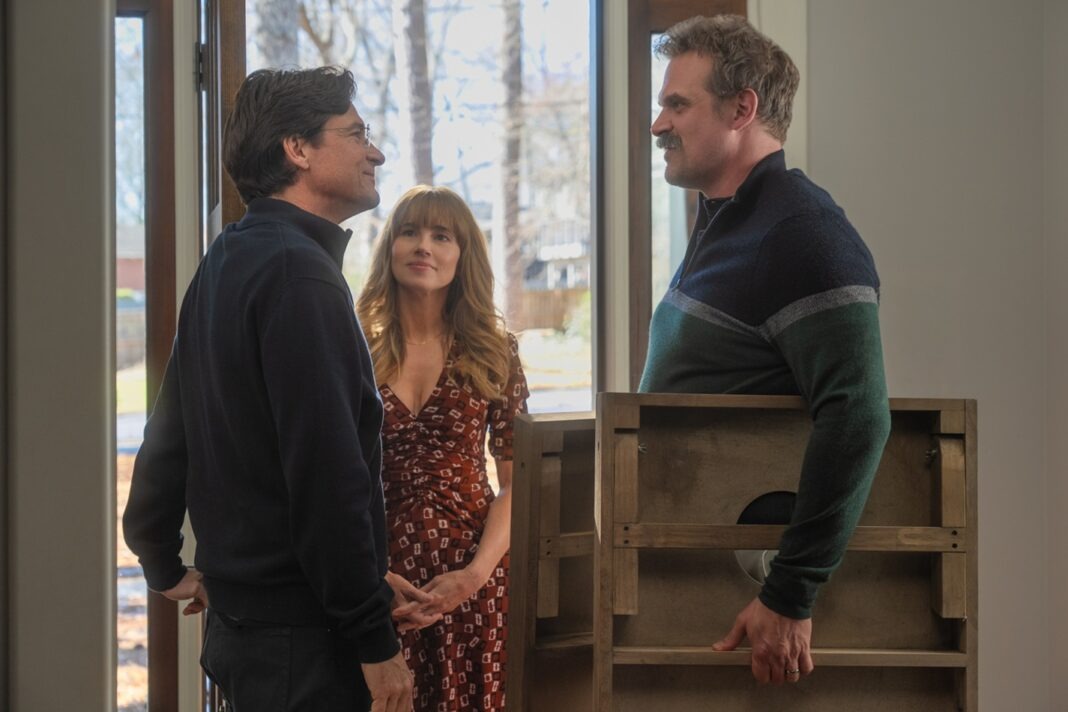
Clark (Jason Bateman) is a weatherman whose face is all over St. Louis, and he one day meets Floyd (David Harbour), who has been assigned to provide sign-language interpretation for him on-air. The two find that they get along quite well, partially because they’re able to appreciate personality traits and hobbies that their families just can’t, like Clark’s affinity for his recumbent bicycle. As Floyd explains how he just isn’t attracted to his wife Carol (Linda Cardelliini) anymore after being unable to picture her in anything but her oversized umpire uniform, Clark and Floyd decide to pursue another source of fulfilment, joining an app meant to help people find connection.
It’s nearly impossible to classify this show within any particular genre, and the best frame of reference is a look back at creator Steven Conrad’s previous shows, Patriot, Perpetual Grace, LTD, and Ultra City Smiths. Both Bateman and Harbour have other Emmy-eligible projects streaming on Netflix this season – Black Rabbit and Stranger Things, respectively – and this show offers them the chance to do something completely different, with both much more muted than usual, fleshing out people who have plenty of opportunity to interact with others yet never seem to be able to show their true selves.
The result of this fusion of Conrad’s mind and his leads’ talent is something truly intriguing and quite mystifying. Clark is a public figure who at first glance seems to be quite happy, and is in many ways much better set-up than Floyd, who doesn’t have much going for him and also seems quite dissatisfied with his body after putting on some weight. Watching them get to know each other and figure out how they can best give the other what they need – a biking companion and some tips on how to get life back on track, among other things – is a fascinating and captivating process.
Bateman and Harbour are both as good as they’ve ever been in these roles, bringing something unique to the way in which these grown men are portrayed. They’re complemented extraordinarily by Cardellini, who has shown extraordinary skill blending genres with her fantastic turn in Dead to Me and offers something even richer and more difficult to crack in the best way here. As law enforcement officers with radically different approaches, Richard Jenkins and Joy Sunday add just the right degree of entertaining quirkiness to a show that defies genre.
There are so many layers to DTF St. Louis, which provided just four of its seven episodes to critics for review, that each installment feels like an entirely new start to the same story, presenting events and situations from another angle that adds infinitely more context. It’s very possible that this show’s plot wouldn’t be nearly as interesting was it not for its expert packaging, ensuring that even the most mundane developments feel substantial and even earth-shattering. How audiences will feel after watching it isn’t guaranteed, but this is one quirky rabbit hole very much worth diving into with the most open and curious of minds.
Season grade: 8/10