What hope is there for a world where free thought has been essentially extinguished, and any act of defiance is punished swiftly and unforgivingly? The Handmaid’s Tale explored that universe with a protagonist who knew what was on the other side and had lived previously as someone able to make her own choices. The sequel The Testaments focuses on a different group of people who, for the most part, haven’t known what it is to be autonomous and capable of shaping their own destinies. This new approach to a familiar subject offers fresh food for thought about how people become who they’re meant to be, often because of and in spite of their circumstances.
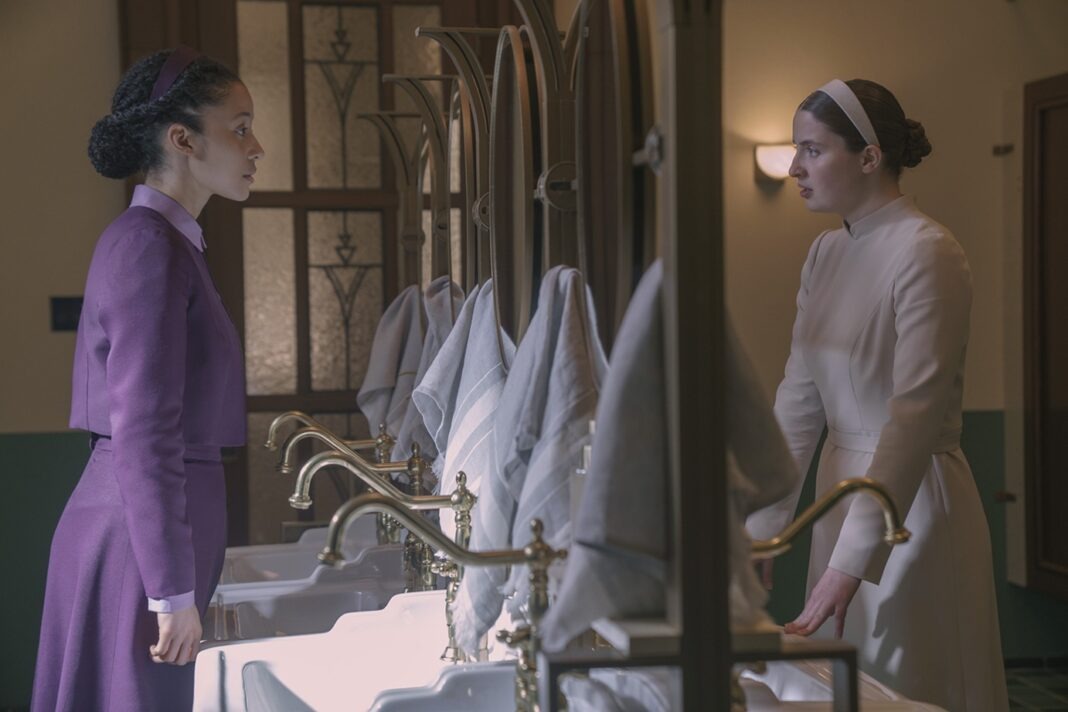
Agnes (Chase Infiniti) is a Pearl Girl, a young woman in Gilead trained carefully by the Aunts so that she can eventually become the dutiful wife of a Commander. Aunt Lydia (Ann Dowd) supervises the school she attends, with Aunt Vidala (Mabel Li) and Aunt Estee (Eva Foote) monitoring the day-to-day activities and ensuring that the girls follow all the rules. The arrival of Daisy (Lucy Halliday), who grew up in Canada and has voluntarily chosen to leave her life of sin behind to become a Pearl Girl, prompts new questions and considerations for these girls who have been taught there are severe consequences for ever even thinking about stepping out of line.
This show’s premiere just one year after the conclusion of The Handmaid’s Tale ensures that it will be very much linked to that series, coming to TV audiences considerably quicker than the book, which Margaret Atwood wrote thirty-four years after the first novel. Her voice still remains, as does that of creator and showrunner Bruce Miller, with Dowd reprising her role to offer another degree of continuity. But this show does feel like its own thing, capable of inviting an entirely fresh audience, mostly because these protagonists face this world with a mixture of innocence and curiosity, which grows at a steadier and less chaotic rate than the rebellious and indignant attitude (rightfully) expressed by Elisabeth Moss’ June from the very start of The Handmaid’s Tale.
Comparisons between the two series are inevitable, but it’s important to note that this show largely stays away from the brutal violence suffered by those who go against Gilead. The reaction to any offense, however minor, is still very overblown and quite disturbing, meant to stifle any further dissidence, but these girls have been mostly sheltered from the truth of what Gilead really is. That allows for a fuller focus on the journey that Agnes, Daisy, and the others go on and to delve deeply into how they move through a world manufactured to force and manipulate them into submission.
Making this show a separate entity is a smart choice, and while there a few cameos and references to familiar faces, it mostly stands alone. This version of Aunt Lydia is still formidable and fiercely protective of the women in her charge, and one flashback episode allows for a more significant peek into her backstory that helps to give much fuller context to how she became who she now is. The contrast of female and male characters also adds dimensions to how this form of gender inequality might seem less overtly objectionable to outside actors, subservient and respectful in a way that’s painted as historically traditional yet clearly meant to suppress individuality and any challenge to authority.
Coming off the wild success of Infiniti’s first feature film, Best Picture winner One Battle After Another, it’s interesting to see her in a much more reserved project that doesn’t have her facing action but instead a much more gradual buildup of passion and energy in a fiercely controlled setting. She’s well-matched by Halliday, whose only previous credits are Blue Jean and California Schemin and who brings a significantly more bitter and impatient sentiment to someone who is far from home. This young cast is brimming with talent, showcasing a variety of expected and surprising responses to an oppressive existence. The Testaments proves that there’s more story to tell in the dystopian world of The Handmaid’s Tale, and that the next generation really is our future.
Season grade: 7/10