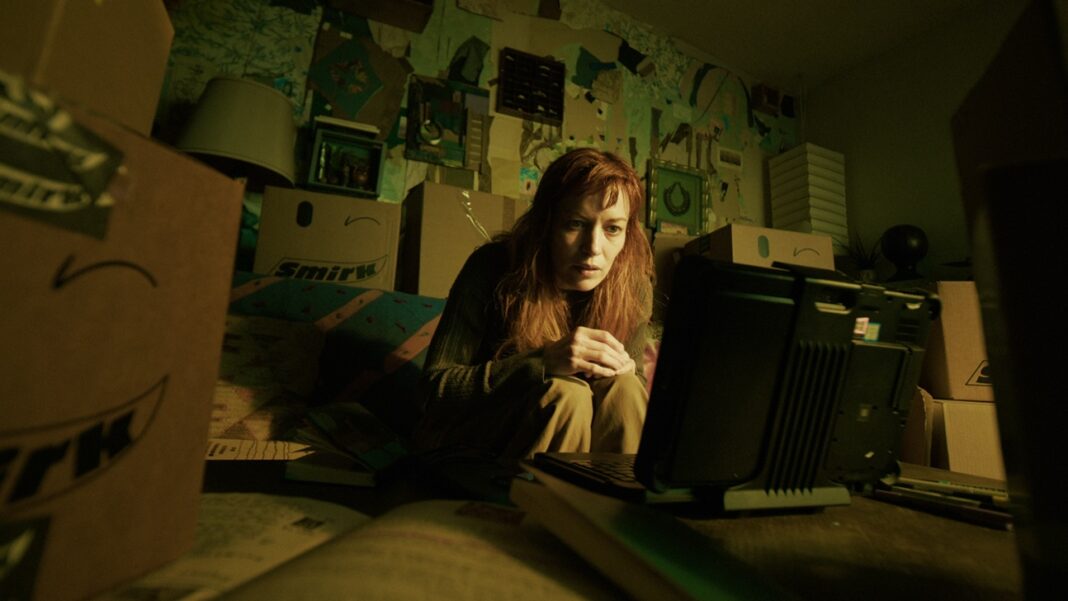
Companies like Amazon have made it so easy to click a button and order something online to be delivered quickly right to your door. Those services are far from perfect and do often make mistakes, but not getting an expected package, however disappointing, isn’t quite as unnerving as receiving something that was never ordered in the first place. Even if it was an item that might have been desired, not knowing why it was sent or by whom can be very troubling. Sender takes that to the extreme, opening with an already shaky protagonist and watching her unravel as she begins to doubt what little she does know to be true.
Julia (Britt Lower) is a newly recovering alcoholic who has been fired from her job and is living in a house rented by her realtor sister Tat (Anna Baryshnikov). She receives daily package deliveries from Smirk, dropped off by the same driver, Charlie (David Dastmalchian), who spends a bit too much time talking to her not to indicate a person interest in her. When she starts getting packages she didn’t order, she descends into paranoia, convinced that someone is deliberately taunting her and trying to drive her crazy.
This is the feature directorial debut of Russell Goldman, based in part on his 2022 short Return to Sender. He very accurately describes the film as a big swing, one that is indeed quite bizarre but which is quite deliberate in every scene. It’s hard to know exactly when events are taking place since there are frequent flashes that seem to merge memories, hallucinations, and the present moment without distinguishing which is which. The camera often changes position, looking up at Julia as she’s drinking from a mug or using a computer, warping the audience’s perception of reality as Julia doesn’t notice that anything is different before inviting her on the same dark journey as she becomes increasingly undone.
The world in which Julia exists is also very purposefully established. She flashes back to a bender but otherwise spends all of her time alone in this house that’s refilled regularly with boxes, interacting only with three people: Tat, Charlie, and Wendy (Rhea Seehorn), an angry executive who repeatedly refuses to be Julia’s sponsor. She does meet a former colleague (Utkarsh Ambudkar) at a meeting who seems to be much more well-adjusted to sobriety than she is, but otherwise that’s the extent of her universe. She works in odd places around her home, sitting with her computer on the stairs and projecting her computer screen onto the ceiling, and it almost seems as if she’s in danger of being sucked in by a screen or a phone as she lives this very isolated existence.
Much of Julia’s antics go unexplained throughout the film, even if some questions are answered by its end. That may result in a frustrating experience for some audiences, but there is enough intrigue her to ensure that anyone watching is sitting up straight in their chairs, wondering what mania will come next. Julia, as portrayed by Lower, is a magnetic manifestation of chaos who could implode at any moment, and watching her here is just as captivating as it is on Severance. The way in which she punches boxes to open them is particularly unforgettable. It’s fun to have someone frequently nominated alongside her for TV prizes, Seehorn, in a role that challenges her to tap into even more sardonic fury than usual, and Dastmalchian and Baryshnikov complement these two intense figures well with more sedated, subservient turns.
It’s not always clear what Goldman is going for and what conclusions he wants audiences to make from what he shows them, but there is a sincere and impressive intentionality to every choice he makes. It’s impossible to escape this film while watching it, and just as easy to be sucked into Julia’s heightened state of mind. This is a role that Lower is so incredibly suited for it would be hard to imagine anyone else in it, building tension almost out of thin air to transform a contemplative premise into something equally engrossing and maddening.
Movie Rating: 7/10