What does it mean to travel to the past? Most people would likely find it interesting to see how people lived and how the world felt different, but one key reason to go back in time is to escape the harsh environmental conditions that define the planet Earth today. Returning to an era of cleaner air and a less explosive population could be a solution to whatever horrible end climate change has wrought, provided, of course, that it doesn’t change the course of history. Future Tense offers an insightful and intimate look at the true value and potential of a visit to a different time.
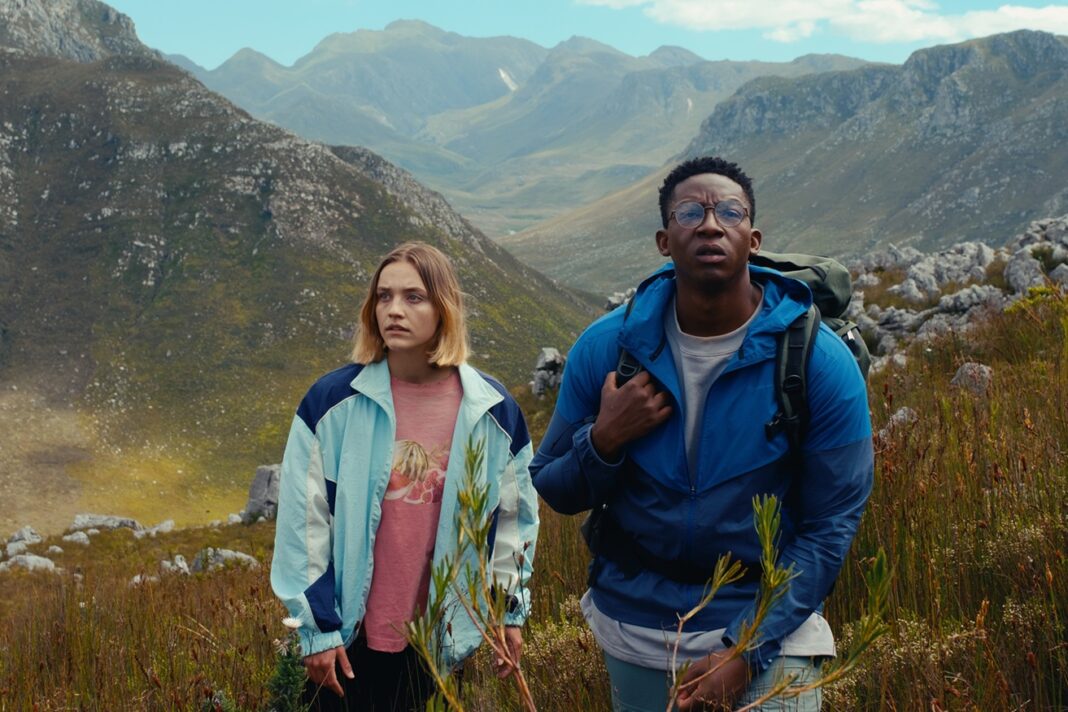
Lwando (Lawrence Maleka) has won the opportunity to go back to 1647 for a vacation of sorts, and he’s bringing his girlfriend Tara (Kristen Raath) with him. There are clear rules set in place, like that it’s a fully catered experience, since the presence of fresh produce could be immensely problematic for the ecological landscape where they’re going that looks nothing like the decaying state of their present-day world. When they arrive at what is essentially the equivalent of an off-the-beaten-path AirBNB, a romantic getaway turns into something very different when Lwando shares his intention to do precisely what those who own this technology want to prevent: cause a massive ripple in the fabric of history.
Writer-director Jenna Cato Bass offers a stunningly inventive look at the notion of time travel, one that strips away most science-fiction conventions and pares it down to a story of just two people who are in one place and then in another, with the ideas and intentions they have as a powerful force to guide them. Anyone hoping to see what life looks like in 1647 will find little satisfactory here since the home they come to is a modern, state-of-the-art facility that has been constructed on empty land and is patrolled by armed guards, ensuring that this little slice of serenity doesn’t permeate beyond its carefully-sculpted boundaries.
The concept of going back in time simply to have a clean space in which to live has been explored previously in film and television, with the short-lived series Terra Nova a great example. But that show featured an enormous budget and the presence of dinosaurs, suggesting that it wasn’t necessarily possible for humans and earlier species to coexist. Future Tense posits the opposite, presenting a completely bare landscape that isn’t in any way chronologically identifiable, while instilling one of its protagonists with a fervent desire to correct a very human error that he believes has the possibility to better hundreds of years of negative events and, should he succeed, create a far better timeline.
This is an ambitious story to pursue in just over an hour and a half, and it feels like there’s an infinite amount of narrative that could have further been incorporated and still remained quite interesting. But that’s the challenge which this film threads successfully, offering just a peek at what this type of technology could mean, especially when used by people with a rich knowledge of history, deep intelligence, and fervent passion to effect change. It’s a far more intimate companion to Orson Scott Card’s novel Pastwatch: The Redemption of Christopher Columbus, interrogating the stability of history and asking what just one person with the right determination and means could do as well as whether things can truly be altered or if they’re fated to go down roughly the same path eventual as the universe corrects itself. Bass can’t hope to address all these themes fully, but the film packs in an impressive amount of quickly-conveyed concepts to ensure that, like the characters in this film and what they hope to do, it’s not soon forgotten.
Movie Rating: 8/10
Future Tense makes its world premiere in the Centrepiece section at the 2026 Toronto International Film Festival.