As people move through different phases of their lives, they’re likely to gravitate towards spaces that feel comfortable. For some, that may be the religion and culture that they grew up with, provided they have positive associations with those things, while for others, finding something far away from what’s familiar can be a safer and healthier choice. The Daughters of Abraham follows two old friends with religious backgrounds that don’t align whose reunion reminds them both of what brought them together and also of what has the potential to keep them apart.
Myriam (Melissa Guers) and Eva (Ava Baya) see each other for the first time in a while as they’re spending time over the summer holidays. Their first meeting indicates some lingering tension and unresolved issues, but they’re soon drawn in by memories of what brought them together in the first place. As they spend more time together, the less sweet moments bubble towards to the surface and threaten to explode when Myriam is invited to stay for a Shabbat dinner with Eva’s family by her mother, who mistakenly believes that she is Jewish, unaware that she is actually Muslim.
The Daughters of Abraham marks the feature film debut of director Hanaël El Yousfi, who previously explored the intersection of religious identities in her short film Mazel Brouk. This film’s title emphasizes the unspoken bond between those who share certain faith traditions, even if they may take very different forms in how they’re practiced, and whose cultures tie back together to the same beginnings before diverging along separate paths. Their religions don’t come up in daily conversation but do become relevant with perceived slights and loaded comments that suddenly catapult them to the forefront of everyone’s mind.
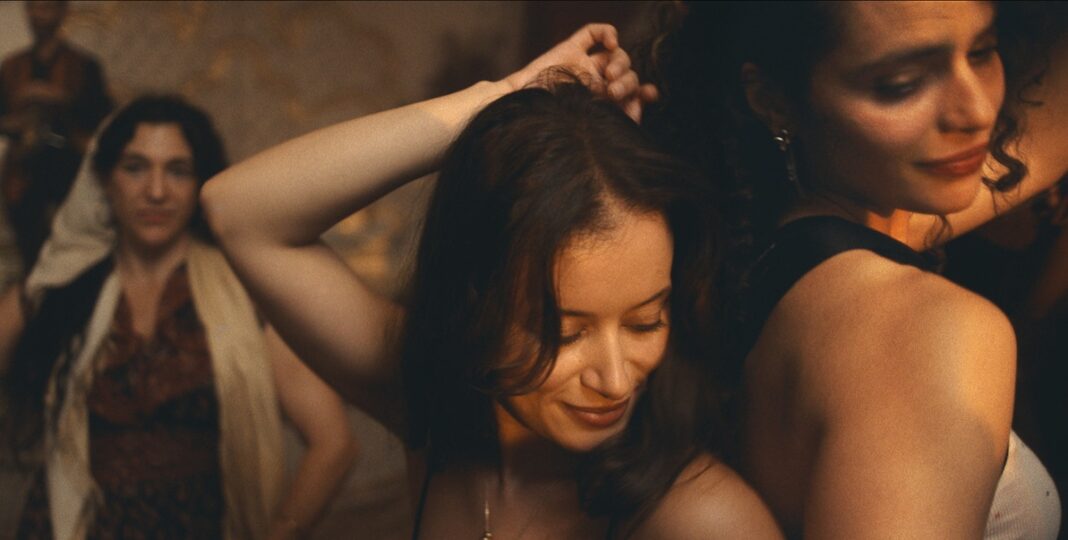
When Myriam and Eva are in sync, it’s mesmerizing to watch them together. The film’s signature still sees them dancing back-to-back at a party, completely in tune with each other and totally immersed in the music and the moment. When they stop to process what they’ve been through and what caused them to drift apart, it’s just as interesting, even if it does serve as an interruption from the magical connection that can’t be explained or understood but is simply felt by watching how they look at and care for each other, uninterested in anything else in the world when they’re at their best.
Both Guers and Baya starred in Mazel Brouk, and their promotion to feature leads is well-deserved. Each imbues their character with a great deal of personality, one that morphs as needed based on who they’re around, changing from an audience of strangers to friends to family. They carry the weight of whatever it is that they’ve been through, some of which is shared throughout the film and some of which remains a mystery, and how that leads them to comport themselves and to interact with a society that doesn’t always want them to be or to express their full selves.
The Daughters of Abraham is not just a film for those who consider themselves adherents to one of the three Abrahamic religions, in part because this isn’t a showcase of particularly observant people who connect with their faiths. That’s the backdrop for their connection and something that often causes as much friction as it does fluidity, and serves more as a marker of the heritage that unites and divides them than as a guiding principle in how they live their adult lives. Guers and Baya are both extraordinary, and El Yousfi shows great skill in her first feature film effort.
Movie Rating: 7/10
The Daughters of Abraham makes its international premiere in the Discovery section at the 2026 Toronto International Film Festival.