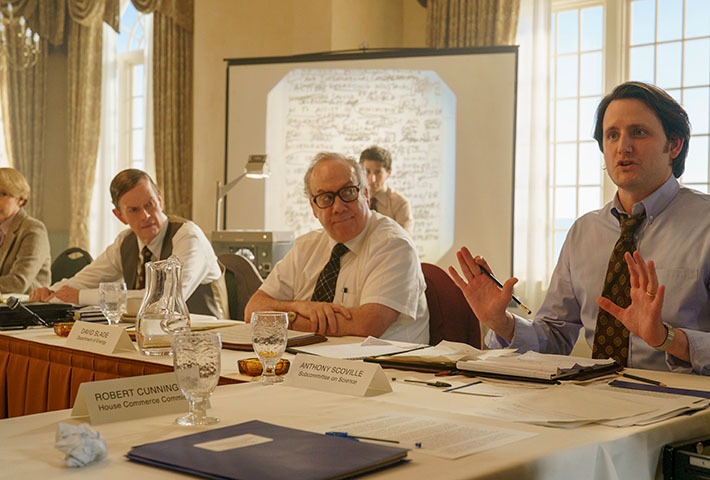
Putting a group of people in a room together with the expressed purpose of creating a statement can either be a straightforward or a daunting task. If everyone is automatically in agreement, the question of the need for such a meeting arises but resolution is quickly achieved. In the case of a myriad of perspectives, coming to a consensus can be considerably more challenging and might even be impossible. This dramatization of a 1980 convening on climate change uses and stays true to a transcript as the basis for its story but adds a great deal through the expressions, movements, and outside interactions of its many players.
It’s four days before the presidential election in which Ronald Reagan is running against incumbent Jimmy Carter. Twenty scientists and lawmakers representing various departments and agencies have gathered in St. Petersburg, Florida. Their mandate, over the course of thirty-six hours, is to discuss carbon dioxide emissions and produce a statement that reflects their agreed-upon findings and any recommendations they might have for steps to be taken to address them. A moderator is there to guide the conversation and ensure that it remains productive and that all voices are heard in the process of finding some common grounds upon which all parties can agree – or, as is stated in the film’s opening scene – don’t disagree.
A Statement comes from director Tom McCarthy, who just over a decade ago helmed the Oscar-winning Best Picture Spotlight. While the subject matter discussed within this film is certainly as serious – the fate of the human race and an increasingly unhealthy planet – its tone most definitely isn’t. Based on Nathaniel Rich’s Losing Earth, the script adapts moments from the transcript verbatim and adds a few select sequences from outside the room that highlight both relevant exchanges to the discussion and less focused levity as these people seek to unwind from the gravity of what they’re discussing. It’s an effective combination that highlights the burden of this committee’s responsibility and seasons it with a more relatable human factor that allows for the infusion of humor and, more than a few times, pettiness.
On its way to its Oscar win, Spotlight picked up a Screen Actors Guild prize for its ensemble performance. That honor is even more deserving for this stacked cast, which recognizes that, while not all parts have equal screen time, they’re all critical and need the right performer to sell their credibility. Among the standouts are Evan Peters as an environmental advocate who has been warned not to play his hand too sharply, Paul Giamatti as a disgruntled bureaucrat who has sat through hundreds of such meetings, Amy Ryan as an expert who feels entirely out of her depth, and John Turturro as a nuclear engineer more than eager to share his prophecies of doom via slide projector. Noah Robbins is very strong as one of the panel’s organizers, who works closely with Paul Rudd’s neutral moderator, and Nina Arianda adds wondrous personality to the stenographer who does get a chance to speak when the film leaves the confines of the room.
This film might have been interesting enough as a text study of the transcript to see what people chose to say and not to say, and to hear how those desperate for action pushed for verbal clarity while those less willing to give any concessions twisted themselves into knots trying not to say anything. What the film adds which makes it essential viewing are the glances and body language that accompany those words, and the camera angles that show various perspectives around the tables – as well as how those tables should even be set up in the first place to encourage productivity and to ensure everyone can participate and see the visual aids. This film has an understandably desolate outlook given the clear lack of lasting progress made by this committee given the state of the climate today, but involves much entertainment on the way to get there. This film’s plot may not offer a blueprint to environmental sustainability – though it does provide considerable evidence and argumentation for analysis – but its structure and presentation do mold a standard for how to transform existing records into something living, breathing, and very watchable.
Movie Rating: 8/10
A Statement makes its world premiere in the Spotlight section of the 64th New York Film Festival and will be released theatrically by Sony Pictures Classics later this year.