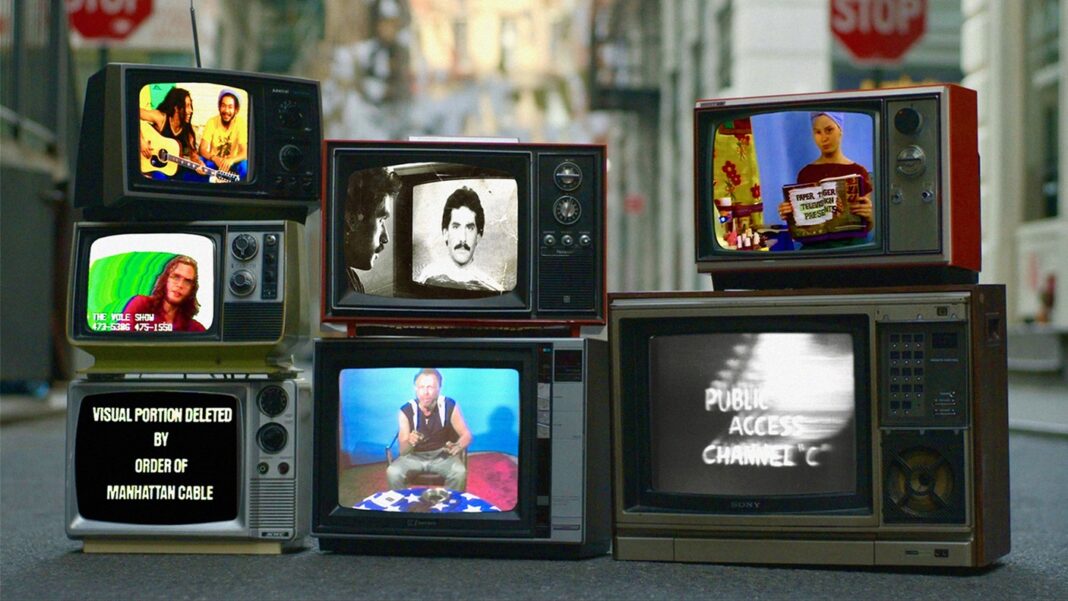
It’s almost impossible to imagine in today’s Internet and smartphone age what it would be like not to be able to find exactly the content someone is looking for, with the possible exception of certain world governments blocking – successfully or unsuccessfully – certain sites or applications. By comparison, the unfiltered and uncensored nature of Manhattan Cable Television beginning in the 1970s feels quite tame. David Shadrack Smith’s Public Access offers a startling and informative window into what once was considered horrific button-pushing to some and vital free speech to others in a documentary that feels appropriately dated and evocative of its time.
The establishment of a mandatory public access channel as part of New York’s cable package for all subscribers with no oversight led to places both predictable and unpredictable, with free reign inspiring a range of content that was by no means all designed or intended to offend. Rather, the primary motivation was to think outside the box, which for some meant showcasing an alternative culture that couldn’t be on mainstream television and resultingly didn’t represent a polished or deliberately-edited finished product that all audiences could watch without risk of having to seriously contemplate something previously unencountered.
Shadrack Smith makes a strong feature directorial debut after helming a number of TV documentaries. For a film about going against the grain, its construction is actually quite standard, but that works to its advantage. Archive footage is key to understanding how these people acted and what they thought was necessary to share with their viewers, and the collected commentary from that era and from participants still around today adds just enough flavor and spice to grasp the impact that this mysteriously authorized experiment has had on the evolution of media to the present day.
There is so much to unpack in just over 100 minutes that this documentary just barely manages to scratch the surface of a phenomenon that will surely invite some audiences to do a deep dive, but it still feels like an effective introduction that gives an appropriate taste to those wholly unaware of this history. Much comes from pure curiosity, like the idea of filming a baby being born because it’s simply incredible to see happen, to a true intentionality, like providing advice for safer sex in an epidemic when the AIDS crisis hits and this platform has the opportunity to make a difference, particularly for a portion of the population it counts in large numbers among its viewers.
There is an off-kilter wackiness to much of the content featured that makes this film feel both irreverent and fun, like the guideline that there can be no closeup on genitalia for more than six seconds being addressed with a placeholder sign reading “Visual Portion Deleted by Order of Manhattan Cable” to name and shame the censors directly, or the need to put a large dot over such body parts leading to the dot floating all too freely across the screen and away from what it’s meant to be covering. The development and transformation of Squirt TV, which began on public access before moving to MTV, also showcases the questionably necessary insertion of censorship and rules to preemptively avoid charges of objectionable content rather than in response to something problematic actually being shown.
Public Access is a dizzying, immersive primer into the wild world of public access television and the way in which it played out specifically in New York City over several key decades. Its format and style pay homage to the tone of the programs and people featured, intent on delivering something undefinable which its subjects choose to explain with responses like “What’s the show about? It’s about an hour!” or “The only way you know your audience is out there is when the phone rings.” Watching this film feels like emerging from a time capsule to a world that looks just different enough from what’s being shown on screen, a path to get to truth and discovery highlighted by trial, error, and having a good time without bothering to ask or even consider where point A and point B could be, if they’re even meant to exist at all.
Movie Rating: 7/10
Public Access premieres in the U.S. Documentary Competition at the 2026 Sundance Film Festival.