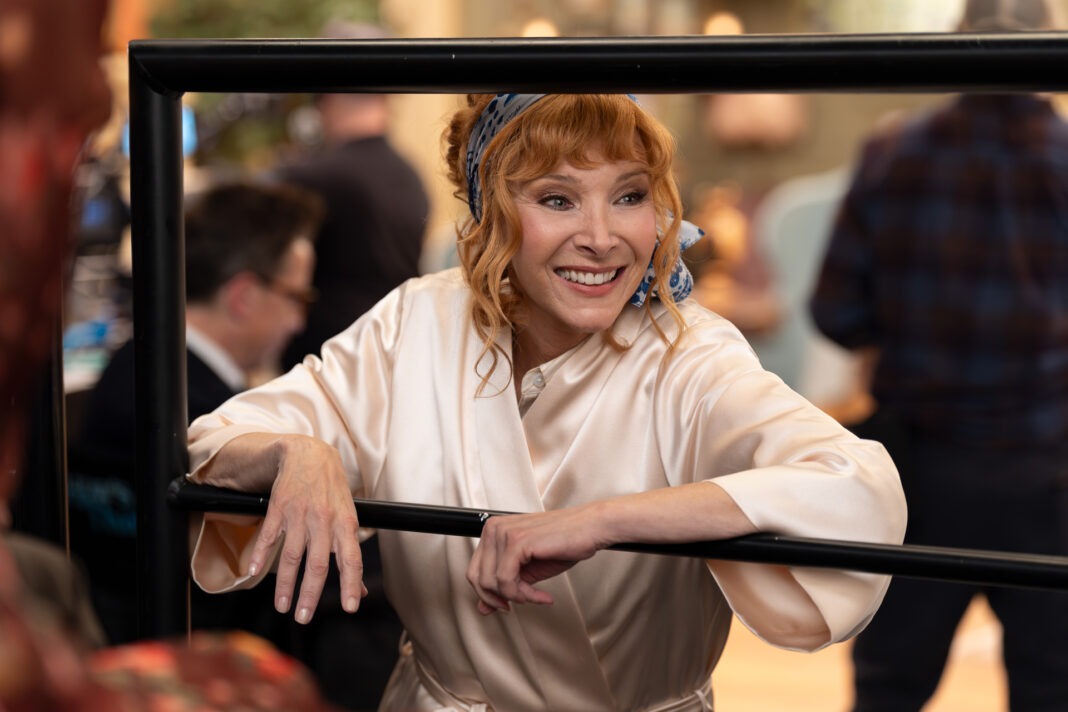
Already an unforgettable household name for her iconic role as “Phoebe Buffay” on the forever beloved Friends sitcom(1994-2004) and for playing “Michele Weinberger” in the 1997 comedy classic Romy & Michele’s High School Reunion, Lisa Kudrow continues to make bold, clever and popular moves within the entertainment industry.
Her The Comeback series premiered on HBO in 2005, debuting her “Valerie Cherish” character to audiences, a once popular young starlet in Hollywood who is now hilariously striving to wiggle her way back into fame and success years later. The series was ultimately canceled after one season – yet with the emergence of video streaming and a loyal cult following growing over the years, The Comeback has returned for another season nearly every decade – in 2014 and 2026, respectively.
Tackling timely topics like Artificial Intelligence, social media demand and a constantly shifting Hollywood industry in a most thought-provoking form of comedy, The Comeback has received two nominations for its third and final season on HBO Max, including “Lead Actress” for Kudrow and “Outstanding Writing” from Kudrow and her longtime co-creator Michael Patrick King. This year’s nominations mark 17 Emmy nominations in total for Kudrow throughout her career so far, with one Emmy win in 1998 for her acting performance on Friends.
We sat down with Kudrow to discuss her creative mindset as she crafted this final season, to hear her thoughts on the hopeful future of comedies in Hollywood and she even took a moment to praise her fellow “Lead Actress” Emmy nominee this year, Jean Smart for Hacks.
JEFF CONWAY: Congratulations on another nomination for Valerie Cherish and the third and final season of The Comeback. You have now been nominated for every season across more than 20 years. Are you able to step back and appreciate what a unique television achievement this has become?
LISA KUDROW: I don’t think it has happened before quite like this—where something gets canceled and then, every 10 years, has another little event. It’s great. It’s super exciting.
JEFF CONWAY: You are also nominated this year for your writing with co-creator Michael Patrick King. When the two of you began discussing whether—and how—to bring Valerie back one more time, was there anywhere you were adamant the story should not go? At the end of Season 2, she appears to reach a new level of self-realization and maturity, and you would not want to backtrack on that.
LISA KUDROW: I think, for the people watching, it looks like self-realization. I don’t know if it is a realization that she actually has. It turns out that she is a decent human being. She can’t leave Mickey alone in the hospital. She just can’t do it.
JEFF CONWAY: What felt most important to you and Michael about the direction of Season 3?
LISA KUDROW: Michael and I were completely in sync. It has been 20 years, Valerie is still around, and she is still working. She did Mrs. Hat, and she is still engaged. She still wants it, and there is something admirable about that. Early on, we realized that what everybody else thought was painful humiliation for Valerie Cherish was not painful humiliation to her. All the spins she has ever done—that ‘it’s okay’ attitude, seemingly taking in a huge insult or an affront and just sloughing it off—you thought she was delusional. It turns out she is actually really great at coping.
JEFF CONWAY: The episode in which Valerie finally confronts her grief over Mickey was especially beautiful. How did you and Michael approach that story?
LISA KUDROW: Michael was really smart about that episode. It made sense that Valerie would not have dealt with it. She still has the ashes and feels badly about that. Then she thinks she has lost them in the move because she has simply put it out of her mind. But she was actually so sickened by the fact that Mickey had to die alone in the hospital.
JEFF CONWAY: Tommy Tomlin arrives in the first episode, and viewers might initially wonder whether he is there to replace Mickey.
LISA KUDROW: Right—and Valerie thinks she is replacing Mickey. Then, of course, it is her first time back on that soundstage. She is hiding it, and you can’t really tell for a long while. Tommy does not know how to do her wigs, and then she snaps. But if you go back and look, it has been building. She is dealing with another tricky costumer who is not paying attention to her. She is now an executive producer—she did not ask for that—and she is trying to help him because she knows the showrunners love that joke. She is being completely disregarded. Mickey would have been able to catch her rolling her eyes in the corner afterward and say, ‘Who does he think he is?’ She is very much alone. I really love that episode and how everything in it plays into everything else. Michael knew we needed to deal with Mickey by the third episode because we did not want people to think we were replacing him.
JEFF CONWAY: One of your fellow nominees is Jean Smart for Hacks. What does it mean to see women in their 60s and 70s receiving this level of awards recognition for such vivid, multilayered characters?
LISA KUDROW: It’s fantastic. It’s thrilling. My favorite part of Hacks is Jean Smart. Everyone is good, but Jean Smart is a gift, and she is phenomenally good. Older women can be interesting because they are interesting. They have been through things. They have experience. That is what is so rich about her character in Hacks and about Valerie Cherish, I think.
JEFF CONWAY: The public has known you and followed your career for many years. Who is Lisa Kudrow in 2026? What brings the greatest passion and purpose to your days lately?
LISA KUDROW: I’m really interested in podcasts about UAPs. That is interesting to me—questions about consciousness, and how it relates to ancient spiritualism or quantum physics.
JEFF CONWAY: Between Valerie Cherish and returning for a sequel to Romy and Michele’s High School Reunion, are you savoring aspects of your work now in ways you may not have in years past?
LISA KUDROW: In years past, you did something and it was done. Unless it was a series, after 10 years it was finished. When something was canceled or ended, that was it. We did not foresee The Comeback continuing this way. What I’m noticing now is how much I am coming to respect these characters that I started off making fun of. You realize there is something really smart about the way they navigate life. Michele Weinberger is the one who is always happy with whatever is happening. That is a fantastic way to live.
JEFF CONWAY: What trends in the industry make you excited about its future, and what do you miss from an earlier era of television?
LISA KUDROW: I love how grounded comedies have become. I also love that television—or streamers, which I guess is now the same thing—has become so cinematic. It is so rich for every department to play in, and I love that. The Comeback was beautifully shot. Our cinematographer, Ellie Smolkin, and Michael Patrick King did unbelievable work. I’m sorry Michael did not receive a directing nomination, but at least we were recognized for the writing and I get to participate in that, which is really thrilling. What I miss are the laugh-out-loud jokes of a multicamera show. Those shows are not always as grounded, so I guess they are a tougher sell, but I hope there is a way for that to come back.
JEFF CONWAY: If you could speak directly to Valerie Cherish after embodying her across three seasons and more than 20 years—and offer advice, a warning, or a comforting message—what do you think she would most benefit from hearing?
LISA KUDROW: I don’t think she thinks much of me! But what I would really want to say to her is, ‘Congratulations,’ and shake her hand. I would say, ‘God, you have been a good person. Good for you.’