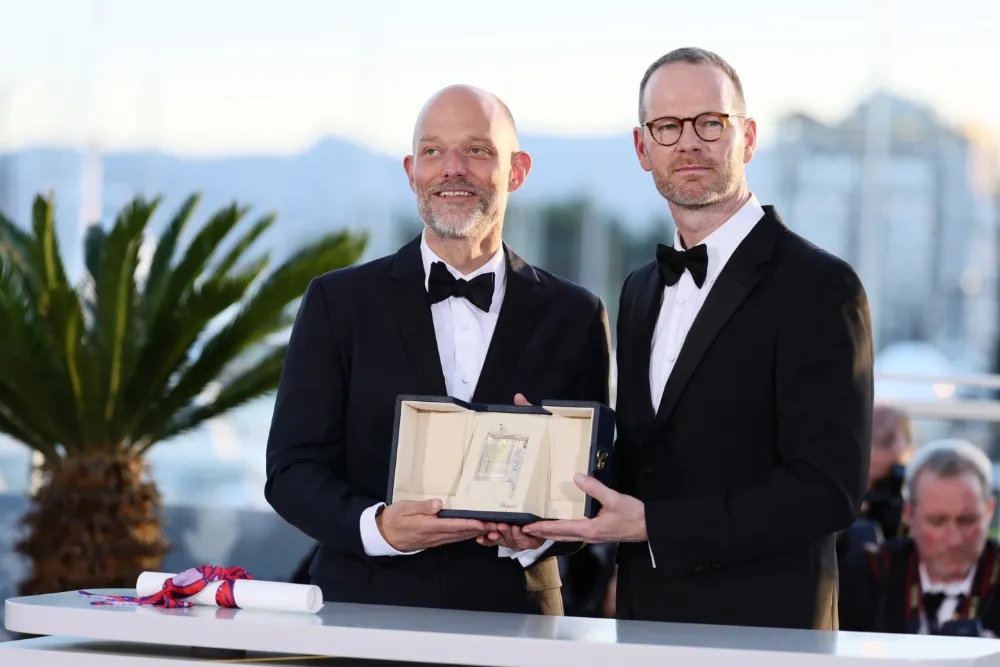
As my last interview for Sentimental Value, I had the opportunity to sit down with writer and filmmaker Eskil Vogt to discuss Sentimental Value as part of our ongoing Oscar coverage for Awards Buzz. I was especially excited to speak with Vogt about the creative process behind one of the year’s most emotionally powerful screenplays. This conversation continues my series of interviews with the talented team who helped bring the magic and wonder of Sentimental Value to life.
In our discussion, Vogt opened up about his decades-long creative partnership with director Joachim Trier and how their collaborative writing process has evolved over the years. We also talked about the extensive time they dedicate to developing their scripts, the deeply personal themes that often shape their storytelling, and the challenge of balancing the film’s heavier subject matter with a tone that still allows space for healing and humor.
Below is my full interview with Eskil Vogt.
We all know that in business it’s not always ideal to work with your friends. Sometimes people butt heads or relationships can deteriorate. When you and Joachim Trier are writing together, how do you collaborate in a way that avoids that?
Eskil Vogt: That’s a good question. When we first started making films, we were very naive about it. We didn’t think, “Now we’re risking our friendship by working together.” It just happened organically. Looking back now, I think about how lucky we are that we’ve had both a deep friendship and a creative collaboration for more than 30 years.
In the beginning, we did butt heads more than we do now. Writing can be high pressure. There are deadlines and practical issues, so sometimes we would argue about very small things, like the wording of a description that we both knew wasn’t actually that important. I think those arguments were just a way of venting the anxiety that comes with creating something. Two days later we wouldn’t even remember what we were arguing about.
Early on, I also felt a frustration that we weren’t professional enough. I would think, “Other people write a screenplay in half the time. Shouldn’t we just lock this down and start writing?” Instead, we would spend time listening to music, brainstorming, talking about personal experiences, or discussing films and ideas that seemed unrelated to the project. But over time we realized that this was our process. Those conversations often ended up influencing the film in ways we couldn’t fully explain.
These days we rarely fight about anything. Joachim is also an incredibly collaborative person. When we write, he never says, “It has to be this way because I’m directing the film.” If one of us doesn’t like an idea, we talk about it until we find a third idea that we both agree on, and usually that idea is better. The screenplay is truly our shared vision. Later, when Joachim works with other collaborators and the film evolves, that’s part of filmmaking. But the script itself belongs to both of us.
What does that collaboration actually look like on a practical level? Do you split up scenes or characters, or is one of you typing while the other dictates?
Eskil Vogt: Writing is much more than typing. Most of the process is simply thinking and talking. We try to spend as much time as possible in the same room together. We meet in the morning and work through the day discussing ideas, structure, characters, and scenes.
Usually it takes us about a year from the moment we start imagining a project to the point where we have a first draft that we’re comfortable showing to others. That means we spend about nine or ten months in the same room just building the structure and deciding what the film will be.
Then I’ll kick Joachim out of the room and spend about two months writing very quickly. I write the first draft of every scene based on what we’ve already decided together. Of course, we haven’t discussed every piece of dialogue in detail, so I write that as well. As I go through the script, I send pages to Joachim and he gives me notes at the end of each day. I incorporate those notes while continuing forward.
By the end of that process we have a rough draft for ourselves. Then we read it, discuss it, and go back into the room together to refine it.
That’s fascinating, especially since it’s almost a full year before you even reach a first draft. Roughly how many drafts did Sentimental Value go through?
Eskil Vogt: We spend so much time preparing the first draft because I love writing, but I don’t love rewriting. I want the first draft to be as close to the final version as possible.
Some writers talk about the “vomit draft” approach, where you just get everything down quickly and fix it later. That doesn’t work for me. I enjoy writing dialogue and getting into the details. If I spend that much time on those details and then have to tear everything apart, it’s very painful.
So I prefer to spend more time planning. By the time I start writing, I’m really excited. Writing the script feels like a reward at the end of the process.
Once we finish that first draft, we usually do a second draft that adjusts things slightly. At that stage we start thinking about budget realities and production challenges. When we write the first draft we try to ignore those practical limitations so we can be completely open creatively. But during revisions we simplify things or adjust scenes so they can realistically be produced.
There’s also another round of adjustments before shooting based on locations, production planning, and rehearsals with the actors. I sometimes watch rehearsal footage and tweak dialogue to fit the actors better. In total we probably do around three drafts, but they stay quite close to the original.
One of my biggest frustrations with a lot of movies today is the screenplay. It often feels like films are shot before the script is really ready. When I watched Sentimental Value, everything felt perfectly structured. Every character and storyline fits together in a way that feels very deliberate.
Eskil Vogt: Thank you. I’ve spoken with American colleagues who say the standard expectation for delivering a first draft is about twelve weeks. That explains a lot.
In twelve weeks I could write something that’s original or something that works well structurally, but I don’t think I could do both. You might write something solid but very familiar, or something original that doesn’t fully work yet. Truly developing something takes more time.
Many of your films deal with heavy themes like death or suicide. Is that something that comes more from you or from Joachim?
Eskil Vogt: Honestly, it comes from both of us. We’ve both had people close to us who struggled with depression or even died by suicide. I’m not sure if that’s partly related to the social environment we grew up in. Norway is a very well-structured society, but it also has relatively high suicide rates.
Those experiences are part of our lives, and they naturally influence the stories we tell. When we include those themes, we try to treat them with care. We never want to use them as simple plot devices. Our goal is that people who have experienced those situations will feel they’re being represented truthfully and respectfully.
With Sentimental Value, we also wanted to explore the idea of generational trauma—how these experiences ripple through families across generations. At the same time, we wanted to suggest that healing is possible. Compared to some of our earlier films, we tried to paint this story on a slightly lighter canvas.
Finding the right tone was one of the hardest parts. The film deals with serious themes, but we didn’t want to give audiences a false resolution where everything suddenly becomes perfect. Real life rarely works like that. What we wanted instead was a sense that people who were far apart at the beginning might at least move closer together by the end.
When people tell me that the film feels both dark and surprisingly light at the same time, that’s incredibly gratifying, because achieving that balance is not easy.
Outside of Sentimental Value, is there another film or performance this year that you think deserves Awards Buzz?
Eskil Vogt: That’s a good question. I’m a big fan of Secret Agent. I know it’s technically competition, but I think it’s a great film. Wagner Moura is excellent in it.
It’s actually been a very strong year for movies overall. There are many great films and performances out there. Of course the Oscars highlight some of them, but there are always wonderful films that don’t receive that recognition. It’s important to remember that as well.
Trailer: